Thursday, 22 December 2022

The Sweet Christmas Bells


We are staying with the Boston-based newspaper The Sacred Heart Review for yet another illustration of how the image of Mass at Christmas time in Penal Era Ireland was presented to a late nineteenth-century Irish-American audience. The paper's 'Our Irish Letter' column offered its readers a romantic and sentimental vision of the old country where Irish exceptionalism is reflected in the claim that 'nowhere is the festive season more religiously observed than in this Catholic isle' because no other country has suffered quite as much as we have in order to do so. The focus of this 1894 piece, 'The Sweet Christmas Bells', by M.J. Roche, is therefore not so much on the image of the Mass Rock but rather on the history of the persecution that lay behind it. The reader is invited not to weep the penal days but instead to hail the courage, endurance and determination on the part of the Irish people and their heroic priests which allowed the faith to survive. Most interestingly of all is that the article concludes with a roll-call of Irish clerical martyrs which the author imagines being read out 'at many an Irish fireside on Christmas night' recalling a time 'when the history of the Irish struggle was written in the best, the purest, the holiest blood of Ireland':

THE SWEET CHRISTMAS BELLS.

Christmas is again with us, and "Our Irish Letter" of today extends to its thousands of readers the compliments of the season — A Merry Christmas and a Happy New Year, with many joyous returns. No need to remind our readers that "Our Irish Letter" columns, week after week, year after year, occupy Old Ireland's corner of the Sacred Heart Review. Scarcely a noteworthy incident has transpired in the Old Land since "Our Irish Letter" made its initial bow to our readers that has not been recorded in its columns. It's aim has been to edify and instruct while it faithfully depicts the Irish news, and strives to infuse into the minds of its readers an ardent and undying love for the faith and land of St. Patrick. Ever ready to raise its voice in behalf of Old Grannuale it has never been found wanting to spring to the aid of any patriotic movement. It has done good and enduring work for the Home Rule cause, and that its services are recognized and appreciated may be judged from the fact that it is invariably one of the first to be called upon for assistance when any project for the advancement of the Irish cause is launched forth by the Irish patriots of Massachusetts. But it is not our purpose to dwell upon politics while the merry Christmas bells are ringing forth their glad message of 'Peace on earth and good will towards men.' Accordingly we shift a slide, and, lo, a wondrous transformation is effected and we find ourselves transported by some invisible power to the Old Sod of the Isle of Saints. 

What a happiness it is for us to be privileged to pass Christmas-tide in dear old Ireland, for nowhere is the festive season more religiously observed than in this Catholic isle. Despite the cruel and oppressive laws of tyrants enacted for centuries, religion flourishes there as vigorously today, thank God, as it did before the penal laws. The blood of our forefathers shed copiously in streams for the faith, the sacrifices they were ever ready and willing to make for the sake of religion, have borne good fruit. Ireland's history is the glorious story of heroic and saintly lives, it brings before us the deeds of her devoted and patriotic sons, and depicts the bright picture of her martyrs and confessors and her gifted students. It tells us how they kept alive in dark and dismal caverns and on the mountain tops the torches of science and sanctity. It points out to us the glorious deeds of the Irish priesthood and shows us what they suffered for love of their country and religion. It incites us to purity of life and nobility of action and teaches us to prize and cherish the holy faith handed down to us at the cost of toil and blood and tears. It also teaches us that — 

We must not weep the penal days 
That sanctified our hills and plains; 
We must not shudder when we gaze 
At men that feared not death nor chains; 
In blood and tears 'neath penal laws 
Saint Erin's heart was purified; 
For holy Faith and Freedom's cause, 
Our martyred nation grandly died. 
 
When peaceful bloomed our garden land 
The hermit and the monk arose 
And every vale heard virgin-band 
Sing love of God, at evening's close; 
But when our air with war was red, 
From cells and caves Truth's soldiers came 
And every rock a glory shed, 
Around some Irish martyr's name. 
 
We will not weep the penal days, the days of the ruin of the dear old convents of the Irish Franciscans and Dominicans, when the inmates were driven forth at the point of the sword and scattered like sheep over the land. We will not weep the penal days which sorely tried Ireland's faith and Ireland's religion. Five pounds was set as a price upon the head of the friar or priest —the same price that was set upon the head of a wolf. They were hunted throughout the land, and when they fled for their lives from their convent homes, the Irish people opened their hospitable doors and said, "Come to us, saggarth aroon." Scattered with no shelter but the canopy of heaven; with no Sunday sacrifice to remind the people of God; no Mass celebrated in public and no Gospel preached; and yet they succeeded for three hundred years in preserving the glorious Catholic faith. The venerable ruins of the Irish abbeys and monasteries tell to this day the tale of Ireland's woe, of Ireland's sorrow. The persecution of the Irish friar, the Irish monk, the Irish priest brought sorrow and affliction to everybody in Ireland. There were upwards of eighty convents of religious —Franciscans and Dominicans —in Ireland before the penal days, and about a thousand priests of each order. Henry began his persecution and was succeeded by his daughter Elizabeth and at the close of the latter's reign, how many of the thousand Dominicans were there left in Ireland, do you think? There were a thousand before and only four of them left— only four. And all the rest of these Irish friars had stained their white habits with their hearts' blood shed for God and for their country. It took Queen Bess twenty years to try to plant the seedling of Protestantism on Irish soil. The ground was dug as for a grave, the blood of the nation was poured in to warm the seed and bring it forth. It never grew; it never raised its tiny head above the soil, it never bloomed. Protestantism could not find root on Irish soil and Ireland was as Catholic the day that Bess breathed her last at Hampton Court, gnawing the flesh off her hands in despair, and blaspheming God — Ireland was as Catholic that day as she was the day Henry the Eighth vainly commanded her first to become Protestant. 

With Elizabeth's death came a little breathing time, and in fifty years there were 600 Irish Dominican priests in Ireland again. They studied in Spain, in France and in Italy. These were the youth, the children of Irish fathers and mothers, who cheerfully gave them up, although they knew almost to a certainty that they were giving them to a martyr's death; but they gave them up for God. Smuggled out of Ireland, they studied in these foreign lands; and they came back again by night, and by stealth, and they landed upon the shores of Ireland; and when Cromwell came he found six hundred Irish Dominicans upon the Irish land. Ten years after — only a decade of years had passed — and again the Dominican friars assembled to count their numbers, and to tell how many survived, and how many had fallen. Only one hundred and fifty were left out of the six hundred; four hundred and fifty had perished — had shed their blood for their country or had been shipped to the Barbadoes as slaves. These are the thoughts recurring to us as we tread the soil of holy Ireland at Christmastide. Small wonder then that the Irish people are so proud of their faith. Do not the very moss-grown stones of the Irish ruins speak of their noble martyrs? As we trudge o'er hills and fields to the midnight Mass on Christmas eve, the grey walls of the Dominican and Franciscan monasteries, glistening in the moonlight, remind us how the Irish people gave up everything they had for years and years, as wave after wave of persecution rolled over them, rather than renounce their glorious faith or their glorious priesthood.

At many an Irish fireside on Christmas night is told the story of Dominick Collins, the faithful son of St. Ignatius, taken by the heretics in the fort at Berehaven and hanged by order of the cruel Mountjoy at Cork; of Maurice Eustace, young, generous and brave, executed at Dublin on pretense of treason against Elizabeth; of Father James Boyton, slain by the followers of Inchiequin at the sieege of Cashel of the Kings, while he administered the Sacrament to the dying defenders of the Holy Rock — Collins, Eustace, Boyton — these and hundreds of others of their order remind us of what the Jesuits did and suffered for Ireland in the penal days. The fate of Thaddeus O'Connell recalls the heroism of the Augustinians; Mulcahy of Clonmel, O'Kelly of Connaught, Fitzpatrick of Ossory vividly recall the patriotism and self-sacrifice of the secular clergy. The members of religious orders and the secular clergy were faithful to Ireland and freely poured out their blood for the cause of religion and freedom, and the Irish people suffered and fought and died like true martyrs, but faithful above all were the noble prelates of the Irish Church. Bishop after bishop, archbishop after archbishop in all the sees of Ireland died gloriously for the faith and the liberty of the Church of St Patrick. And it is to this old Catholic land that "Our Irish Letter" is devoted, to this old Catholic land it has taken its readers in spirit to the midnight Mass in the Irish chapel, to the Irish firesides where the turf blazes so brightly, and the joyous greeting of "God save all here" is heard every time a new-comer crosses the threshold to listen to the glorious tales of Irish faith and patriotism when the history of the Irish struggle was written in the best, the purest, the holiest blood of Ireland. 

M. J. Roche.

The Sacred Heart Review, Volume 13, Number 5, 22 December 1894.


Content Copyright © De Processu Martyriali 2020-2022. All rights reserved

Wednesday, 21 December 2022

The Midnight Mass: A Christmas Incident of the Penal Days in Ireland


Yesterday we looked at the nineteenth-century lithograph 'A Christmas Mass in the Penal Days - The Alarm! containing all of the iconic elements of the people huddled together in the snow while the lookouts rush to warn the priest to flee from the approaching soldiers. Over the next few days we will look at some further examples of how this symbol of the Penal era appeared in the popular religious press, especially that aimed at Irish expatriate communities. We begin with a piece by the Irish-American poet Denis Aloysius McCarthy (1871-1931), who was based in Boston and a regular contributor to its Sacred Heart Review.  The Irish saints and martyrs were a favourite subject of McCarthy's poems, selections from which were often quoted by other writers in an age which enjoyed epic poetry.  In the article below, published in the December 25, 1897, edition of the Sacred Heart Review,  the writer begins with a poem telling of a hunted priest battling the winter wind and trying to evade the authorities to reach his lonely altar beneath the hill. Alas, in this case the warning to flee comes too late and the unfortunate soggarth will say the Midnight Mass no more. It is interesting to see that the poet suggests that despite the makeshift outdoor setting, the quality of the worship at the Mass Rock surpasses anything found at a cathedral. He then goes on to offer a sentimental reflection on what it is to be away from the old country at this time of the year. He seems keen to point out though that such nostalgia is not a denial of all the benefits which America has to offer and stresses the loyalty of the Irish to its banner of liberty. Indeed, McCarthy dedicated his 1906 anthology Voices from Erin 'To all who in their love for the new land have not forgotten the old':

 THE MIDNIGHT MASS.

A CHRISTMAS INCIDENT OF THE PENAL DAYS IN IRELAND.

BY D. A. MCCARTHY.

With stealthy step across the wold 
The hunted soggarth swiftly goes; 
The winter wind is blowing cold 
And round him drives the winter snows; 
But little does he heed the wind, 
The blinding snow, the dark morass; 
With many an anxious glance behind 
He goes to say the midnight Mass! 
 
For hours, with many a devious turn. 
He's led the chase by moor and fen. 
He's seen the village tapers burn, 
But dare not seek the haunts of men, 
For close upon his track have pressed, 
(His holy Faith the only cause) 
With horrid oath and ruffian jest, 
The minions of the Penal Laws. 
 
And woe to him, should evil hap 
Into their hands the priest betray; 
The raven o'er his corse should flap 
Her sable wings before the day! 
But fainter now have grown their cries, 
Their shots more distant than before, 
And hopes within his heart arise 
That he has baffled them once more! 
 
Ah, vain the hope of baffled foes! — 
A few more crafty than the rest 
Still dog his steps as on he goes, 
Still keep the chase with eager zest; 
But, all unconscious, fares he still 
By tangled wood and torrent dread 
To where, beneath a lonely hill, 
The Mass in secret may be said. 
 
"Oh, failte! failtel" —round him throng 
The remnant of his scattered flock, 
And Mass with neither chant nor song
 Is offered from a fallen rock; 
And never at cathedral shrine 
Were purer spirits wrapt in prayer
Than those who worshiped the Divine 
Before that lonely altar there. 
 
But, hark! The rite is scarcely done 
When rings a cry upon the breeze; 
"Up, Father — for your life — and run!" 
The soggarth rises from his knees— 
Too late! One muttered prayer to God, — 
A volley shakes the mountain-pass,— 
The priest lies dead upon the sod 
He'll say no more the midnight Mass! 

At Christmas time all hearts turn homeward. The present is forgotten, the future ceases to allure, and the past is before us again in all its brightest lights and tenderest shadows. We forget the long, dreary years of separation, the vicissitudes of time, the strange scenes and faces with which we have become familiar during many a day of exile; and, once more, the old home, the family circle, unbroken yet by absence, the loving faces of parents and of brothers and sisters, are presented to our gaze; and few indeed are the hearts that do not beat faster, and few are the eyes that are not dimmed with tears at the memory of old times. 

To the Irish exile, particularly, this season of Christmas is one of remembrances that are composed of mingled joy and sorrow. For Christmas in Ireland, as in no other country, is a day sacred to family life and love. It would seem, indeed, as if upon that land, ever faithful to the Church through ages of persecution,the Holy Family had showered the richest spiritual blessings, for the affection that obtains in pious Irish households among the various members of the family is akin to that love which bound together the three principal actors in the great mysterious drama at Bethlehem. It is therefore only natural that the thoughts of the Irish exile turn back to the old scenes that he may never again see in reality, and to the old friends whose hands he may clasp again only In dreams and "tears of memory," shed at Christmas time over the past are evidence of the deep and holy feeling for home which God has implanted in the hearts of the Irish people. 

The new country, with all its broadening influences, with its atmosphere of freedom, and the possibilities of material advancement that it affords, is very dear to the sons of the Green Isle who have sought and found shelter from oppression and bitter poverty beneath its starry flag. They have increased and multiplied. Their blood courses in the veins of the best and bravest of the citizens of the great republic. In peace they have tilled the fertile lands, and reared upon the boundless prairies the homes that were denied them in the land of their birth; and in war they have been the to grapple with the foes of their adopted country, shedding their blood freely in defense of a banner that is to them the symbol of liberty for themselves, and hope for the old land over the water. 

But the hearts go backward across the leagues of the Atlantic and the years of absence, to their motherland at Christmas. They hear Mass again in the little chapel. They see the gray-haired priest at the altar. They listen to the Christmas hymn of the humble village choir, than which the grandest cathedral chorus is, to them, not more solemn and inspiring. And around them are the friends of their youth, unchanged. 

Of course it is only a dream. But who can say that this return to old times does not make the hearts of the exiles better and braver, bringing them, through home ties, more close to the Babe of Bethlehem, in Whose cause their fathers bore persecution unflinchingly, and strengthening them against the enemies of their race and creed, who would rob them of their love for faith and fatherland. 

D. A. McC.

The Sacred Heart Review, Volume 18, Number 26, 25 December 1897.

Content Copyright © De Processu Martyriali 2020-2022. All rights reserved

Tuesday, 20 December 2022

A Christmas Mass in the Penal Days


If there is one iconic image which can be said to encapsulate the Irish Catholic experience in the Penal era, then surely it must be that of the people gathering at a Mass Rock while lookouts keep watch for the authorities. The one above is called  'A Christmas Mass in the Penal Days - The Alarm! ' by Dublin cartoonist and illustrator John Dooley Reigh (1851-1914) and was first issued as a supplement to the December 20 issue of the newspaper United Ireland in 1884. [1] This late nineteenth-century lithograph has had a deep and long-lasting influence on the Irish Catholic imagination, and framed copies of it can still be found in Irish homes. In the article below, published almost thirty years later for an Irish-American audience, it is clear that the image has already resonated as a symbol of endurance and unbreakable commitment to their faith on the part of the Irish people.  Indeed, 'Midnight Mass in the Penal Days' became a staple among the articles in the popular religious press at this time of the year. One assumes that a picture of an open-air Mass on a balmy summer evening would not have achieved the same impact as this snow-covered setting.  The anonymous writer of the short piece in The Sacred Heart Review below certainly enters into the scene and almost imagines himself present as 'the bitter winter wind drives the cold sleet before it in stinging gusts' and 'the worshipers shiver in the rush of the pitiless blast'. Yet it is the willingness of the Irish people to endure these hardships in order to attend the Mass which is the reason why the faith survived and which leads the writer to conclude that there is a lesson here for us all:


MASS AND THE FAITH.

When people begin to lose reverence for the Mass, they soon begin to lose their faith altogether. Be faithful to the Mass and the Blessed Sacrament, we repeat, and you will infallibly save your soul. If you are cold and distant and careless toward these essential things you are surely on the broad road that leads to destruction. Why was it that Ireland got the wondrous privilege of preserving the Faith through so many long and blood-stained centuries? asks the Catholic Register and Canadian Extension. It was because of the devotion of her people to the most holy sacrifice. It is a cold heart that does not thrill at the heroic apostolic piety and zeal suggested by the picture of the "Midnight Mass in the Penal Days." Under a protecting bush, in the shelter of a rock, or in a cave in the hillside, are gathered the faithful few. The bitter winter wind drives the cold sleet before it in stinging gusts. The priest is at the rude altar, which is nothing more than a rockhewn shelf. The worshipers, close about him, shiver in the rush of the pitiless blast. On the outer hills and peaks, occupying posts of observation, are the sentinels. They are listening for the tramp of armed men, and watching for the deadly glint of bayonets in the chill white moonlight. For the "priest hunter," with his murderous and blasphemous crew, is abroad, and only the mercy of God can protect his prey. The tinkle of a little bell is heard, and every head is bowed, while on the wings of the night is borne the whispered welcome of Him Who has come down into their midst to comfort them: "Cead mile failte!"— " A hundred thousands welcomes, O Christ, the Son of the Living God!" Never in the history of men did the world witness anything more touching, more devoted, more sublime, than the faith and love of the Irish peasant and his priest for the mystery of the most holy sacrifice of the Mass, that merited for Ireland her perseverance in the true faith; and it is devotion to the Mass and the Blessed Sacrament that will merit the same glorious and priceless gift for ourselves. Let us be wise in good time and take the lesson to heart.

 
The Sacred Heart Review, Volume 49, Number 21, 10 May 1913.

Content Copyright © De Processu Martyriali 2020-2022. All rights reserved


 [1] M. O'Sullivan and L. Downey, 'Mass Rocks', Archaeology Ireland (Spring 2014), p.26

Content Copyright © De Processu Martyriali 2020 - 2021. All rights reserved

Thursday, 24 November 2022

The De Profundis and the Irish Martyrs


On November 15, 1960 a decision taken by the Irish bishops at the Synod of Maynooth held four years earlier came into effect. It abolished the recitation of the De Profundis (Psalm 129) after the Mass, a liturgical practice peculiar to Ireland. A report of the decision appeared in the American Catholic paper The Catholic Standard and Times the following month: 

Irish Bishops Abolish De Profundis at Mass

DUBLIN (NC). —A custom dating from Ireland's penal times of reciting the De Profundis for the dead after Mass has been discontinued by order of the Irish Bishops.  The custom is believed to have been introduced during the 17th-century persecution of the Church by Ireland’s English rulers. Its original purpose was to pray for the souls of those who died under the harsh anti-Catholic laws of that period. Recitation after Mass of the De Profundis, the 129th psalm, was peculiar to Ireland. The Bishops decided to abolish the custom in 1956 at the Synod of Maynooth. Decrees resulting from the synod were approved by the Holy See, and went into effect on November 15. Church authorities emphasized that the omission of the De Profundis after Mass does not imply that Catholics should pray less for the dead. The intention of the Bishops was to focus the thoughts of Catholics at Mass on its central idea as a sacrifice.

The Catholic Standard and Times, Volume 66, Number 13, 16 December 1960. 

To learn more of the history of this custom I turned to the work of Father Sylvester Malone (1822–1906), a prolific contributor to the Irish Ecclesiastical Record and other nineteenth-century journals. He traced the liturgical use of the De Profundis in one of his books on Irish Church history noting that, as part of the financial arrangements with the Crown in the medieval abbey of Saint Thomas in Dublin, 'the chapter house, over and above what it was bound to, by its order, was under an obligation of saying, especially on All Souls Day, a De Profundis for the souls of the king, his ancestors, the aldermen, and of the citizens of Dublin'. He goes on to say

And here it is worth while to inquire whence the origin of the De Profundis after Mass, and so peculiar to Ireland. Various reasons are assigned for its use;  but I consider it took its rise from a desire to compensate for the loss of the divine offices for departed benefactors. Prayers in the office were not confined to Ireland. Cardinal Bona assures us that when the number of benefactors became large in every well-regulated community, instead of calling out the names of all benefactors the chanting of the De Profundis, with a suitable prayer, had been substituted. There had been an obligation of making a commemoration in the offices for a stated period or for ever. Hence, on their interruption, that most touching of the prayers for the dead was substituted.  Not, indeed, that there had been a strict obligation to do so. Besides the psalm De Profundis touchingly expressed the helpless state in which the Irish Church was placed by penal laws, and continued a protest against the false religion of the so-called Reformers. What wonder, then, that this prayer, warranted by many reasons during the days of persecution, should continue to the present day after Mass, when we find it in use in the early and middle ages even in Ireland. The Irish Church, so tenacious of ancient customs—its chorepiscopi, acolytes, exorcists, readers, its liturgies—what little reason for marvel that it retained its De Profundis called for by charity if not justice.

Another reason why the psalm in question may be looked on as a commutation for the offices is that it is affected by the same causes, and almost in the same way as the offices. The De Profundis is not said, I believe, at least generally after High Mass or solemn Mass for the dead. Well, even when religious orders were bound by vow to say the psalm De Profundis daily, they were inhibited from doing so on All Souls Day, and on the day of the death and burial. And this happened even though there had been a bequest left for the purpose of saying a De Profundis daily. Again, the nuns of the Monastery of Chagas by a decision of July, 1741, were allowed to chant the Responsory for the dead unless on the most solemn festivals, and even on these to recite it privately in choir, lest the pious disposition of testators should be frustrated. Gardelini also informs us (n. 4687) that there had been an immemorial custom in the Church of Milan, of repeating the 129th psalm (De Profundis) with a suitable prayer after the divine offices for the souls in purgatory, especially those of all benefactors. All this leaves no reasonable doubt that the De Profundis was intended in charity or justice as a compensation for the divine offices interrupted by persecution.

Rev. Sylvester Malone, Church History of Ireland in Two Volumes, Vol. II, 3rd edition, (Dublin, 1880), 219-222.

Interestingly, in an obituary for his father who died in 1997, contemporary Irish composer Patrick Cassidy recorded that his father had suggested using the De Profundis as a final chorus in a work on the Famine which he was struggling to complete. He went on to say:

My father strongly suspected that the Irish pre-Vatican II practice of the celebrant saying the De Profundis after every Low Mass may have had its origins during the Famine. Further research revealed that the practice was, in fact, more ancient. After he and my mother, Kathleen, contacted Archdeacon Cathal McCarthy, they discovered that "the most likely" and "most popular hypothesis" is that the De Profundis "was meant to be part, or really token, of various endowment Masses which, because of the outlawing of the Mass under the Penal Laws could not be said with any assurance."

 It would seem therefore that although the origins of the practice of praying the De Profundis lay in the medieval obligation to honour those benefactors who had endowed religious foundations, it later became linked with the memory of all those who had died during the Penal era, when the Mass itself was placed under restriction and death had to be faced without the comfort of a priest to minister to the dying. In hindsight it is perhaps remarkable that this practice survived in Ireland right up to the middle of the twentieth century.


Content Copyright © De Processu Martyriali 2020-2022. All rights reserved

Monday, 7 November 2022

Companion in Martyrdom: Deacon Matthew Hoare, O.F.M.


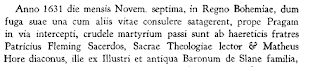
On November 12, 1631, the body of Irish Franciscan Matthew Hoare was laid to rest in the friary church of the Bohemian Franciscan province at Votice. He had been martyred on November 7 along with his confrère and compatriot Father Patrick Fleming as they travelled with a small party of friars from the recently established Irish College at Prague. They were seeking to escape the besieging forces of the Elector of Saxony, but close to the village of BeneÅ¡ov encountered a group of hostile locals who attacked them, leaving Friars Fleming and Hoare dead. Father Fleming was one of the driving forces behind the project at the Franciscan Irish College at Louvain to research and publish the Lives of the Irish Saints. Much less well-known, however, is his companion in martyrdom, Matthew Hoare. Both men bear the surnames of prominent Old English families; Fleming was related to the Barons of Slane, County Meath and the Hoare family was an important one in County Wexford. Scholar of Irish surnames, Edward Mac Lysaght, records that the name is spelt both as Hoare and as Hoar, the latter spelling being found in particular in County Cork. Both spellings are used by different authors for our martyr and unfortunately I have not yet been able to establish when and where he was born. I presume that like Patrick Fleming, Matthew Hoare was sent away from Ireland in order to receive a Catholic education and then entered the Franciscan Order. He appears to have been a young man of some promise and was selected to be one of the small group who went under Fleming's leadership to establish an Irish Franciscan College at Prague.  Fortunately one of the survivors of the attack, Father Francis Magennis, left an account of both the early days of the new institution and of the sad fate that befell its founder and his companion.  He tells us that Matthew Hoare was a Deacon and was chosen as the preacher at the College's opening, which given the distinguished nature of the audience seems to confirm the abilities discerned by his superiors: 

It was on the 2nd of July, 1631, that the Franciscans were publicly inducted to their new establishment in Prague by Cardinal Harrach, Archbishop of Prague and Primate of Bohemia. His Eminence and all the other civil and ecclesiastical authorities of Prague being present, a discourse composed by Father Fleming was delivered with great earnestness and effect by a young Religious, in deacon's orders, named Matthew Hoar,*  who was destined in a few months to be the companion of Father Fleming in martyrdom.

*The writer adds, that Fr. Hoare was chosen on this occasion " ob eminentis ingenii judiciique acumen, felicis memoriae foecunditatem, dicendique gratiam, cum omnimoda morum honestate conjunctam, coram tot ac tantis Magnatibus fiducialiter declamandam eaque ab ipso adeo proeclare, venuste ac plane Angelice, omnium cum stupore, perorata, ut solemnitatem et auditorum devotionem mirum in modum adauxerit. "

 'Irish Historical Studies in the Seventeenth Century, III., Patrick Fleming, O.S.F.', Irish Ecclesiastical Record, Vol. VII, February, 1871, p. 209.

In his 1896 catalogue Our Martyrs, the then Postulator of the Cause, Father Denis Murphy S.J., also used the account of Father Magennis to testify to the martyrdom of Father Fleming and Deacon Hoare:

...The community consisted of six. As their house was very poor, they thought their poverty would be their best protection. But they were warned that their lives were not safe, as many of those among the enemy were infected with heresy. It was arranged that the Guardian and Matthew Hore, a deacon, F. Patrick Taaffe, and Francis Magennis, who was not yet in holy orders, should accompany the Count De Thun to some safer place. ...Early the next morning they set out. They were overtaken by two Servites, who asked them to accompany them in their carriage. F. Fleming refused, preferring to go on foot. Br. Hore, who was quite exhausted, joined them. ...

...As they were approaching the village of Benesave, in which F. Taaffe and Br. Magennis had passed the night, all of a sudden seven peasants rushed out of their house. Three of them fell on the Guardian to rob him. One of them with a blow laid him low; the others rushed to the chariot and attacked Br. Hore....

The Servites fled to the house of the Count De Thun, and told what had befallen their fellow-travellers. The Burgraf von Steinberg arrived soon after, bringing in his chariot the Guardian's dead body which he had met on the road. There were five wounds on his head, from which blood was issuing. The body was taken to the Franciscan Convent of Voticum, seven miles from Prague, and buried there with great honour...

...Soon after, a body of soldiers, commanded by Balthasar Barrady, came thither bringing the body of a Franciscan. He was soon recognized by the other monks. He had received a wound in the side; his heart had been pierced through by three bullets; his ears, too, were cut off. Our Fathers, Gerald Fitzgerald and Francis Welferston, took care to have the body buried, lest it might fall into the hands of the heretics. After some weeks, Count Suorby had Br Matthew's body transferred to Voticum, and buried in the Convent of the Franciscans, which he had founded, in the same tomb with F. Fleming, and took care to have the spot surrounded by an iron railing.

Rev. Denis Murphy, S.J., Our Martyrs, (Dublin, 1896), 263-264.

Two modern Czech scholars have noted the subsequent history of the martyrs' tomb:

The iron grill which Sezima, Count of Vrtba, had made for their tomb was in the course of time removed and replaced by a board with a Czech inscription, which was attached to the pulpit. After the improvement of the interior in 1758, an inscription with similar wording was painted on the wall. When the church was being painted white in 1776, it was damaged and was again renovated by order of the provincial.

Jan Pařez and Hedvika Kuchařová, The Irish Franciscans in Prague 1629-1786 (Prague, 2015), f.n. 59, p. 47.

I have tried unsuccessfully to ascertain if the tomb is still extant. 

Although, as we have seen, the case of Deacon Matthew Hoare was one of those featured by Father Murphy in Our Martyrs, his name was not among those submitted to Rome for official consideration and does not appear on the Official List of Irish Martyrs. It is customary for the cause of a martyr to come under the jurisdiction of the Bishop in whose diocese the death occurred, but I do not know if the cause of Friar Matthew was ever formally adopted or where it now stands. As with Father Fleming, I can only regret the tragic loss of his companion in martyrdom, another young man of drive and ability who was so cruelly denied the chance to serve his order and his college, thanks to the brutal death he met far from Ireland's shores.

Content Copyright © De Processu Martyriali 2020-2022. All rights reserved.

Monday, 31 October 2022

How an Irish Bishop Died for Faith and Fatherland


The hanging of the Dominican Bishop of Emly, Terence Albert O'Brien, O.P. on October 31, 1657, following the siege of Limerick, is one of the cases of Irish martyrdom which left a lasting impression on subsequent generations. In part I am sure this was because of the details preserved by the martyrologists of the time, most notably Bishop O'Brien's prediction that his persecutor, the Puritan General Ireton (who was Oliver Cromwell's own son-in-law), would soon be standing before God's tribunal himself. When Ireton contracted the plague ten days later it was reported that he said he had wished he had 'never set eyes on that Bishop' and attempted to distance himself from any responsibility for the execution. As a further testimony to Bishop O'Brien's status as a martyr, which would have been understood at the time, it is also recorded that fresh blood continued to drip from his severed head which did not show any signs of decomposition. All of these details feature in the article below published in an Australian newspaper in 1905. A year earlier the Archbishop of Dublin had opened the official inquiry into the Irish martyrs, something which was of interest to expatriate Irish communities. This well-written piece on Bishop O'Brien is attributed to 'J.B.' who concludes with the verdict that "He was taken and hanged, because of the great things he had done for the Faith."

How an Irish Bishop Died for Faith and Fatherland

Terence Albert O'Brien, O.P., a scion of the Royal House of Munster, and Bishop of Emly, was taken and hanged because of the great things he had done for the Faith, on All Saints Eve, A.D. 1657.
He was staying in the City of Limerick when that city was besieged by Ireton, the son-in-law of Oliver Cromwell. He was offered a bribe of 40,000 gold crowns, and a pass to any place he pleased, if he would quit the city, and cease to urge the citizens to resistance, all which he refused, preferring to give help to the Catholic people up to his death.

When the city was taken on the 29th of October, the articles of capitulation exempted twenty-four persons from quarter. Dr. O'Brien was one of these, and being arrested, he was brought before Ireton, who ordered him to be tried by a court-martial. When asked did he want counsel, he calmly replied that he knew his doom and only wanted a confessor. This boon was granted, and Father Hanrahan, a member of his own Order, was suffered to pass the whole day and night of the 30th October with the Bishop in his cell.

 On the following day the finding of the Court was announced to him, as he lay stripped on a pallet; and the officer charged with this duty gave him to understand that the sentence was to be carried out on the instant. On hearing this, he got up to dress himself, but before he had time to do so, the Provost-Marshal's guard pinioned his arms, and thrust him out of the cell almost in a state of nudity. It was only natural that his fine sense of delicacy should resent this cruel insult, but finding that all remonstrances were even lost on the posse who surrounded him, he paused an instant as if to collect himself, and said in a solemn tone that "the time was not distant when Ireton should stand before God's tribunal to account for his bloody deeds."
It was a long way from the prison to the place of execution, and as the cortege proceeded, it was encountered at every step by sights the most appalling. For two days previously, Ireton's troops had been allowed to pillage and slay as they liked, and there was hardly a house that did not bear witness to their licentiousness. Windows shattered, doors wrenched from their hinges, corpses of men and women lying stark in the gutters, wares of every sort scattered and trodden under foot, showed that destructiveness had revelled to satiety. No living thing appeared along the route of that sad procession, and the universal stillness would have been unbroken were it not for the heavy tread of the doomed man's escort, and the ringing of their weapons as they clanked on the pavements.

The Bishop conducted himself with his accustomed firmness, and though distressed at being obliged to parade the deserted thoroughfares on that winter's evening in a state little short of absolute nakedness, his step was as steady and his bearing as erect as either could have been on that memorable day when he followed the trophies of Benburb to St. Mary's Cathedral.
On reaching the foot of the gibbet, he knelt and prayed till he was commanded to arise and mount the ladder. He obeyed, seized the rungs with vigorous grasp, and turned round as if anxious to ascertain whether any of the citizens had ventured abroad to witness his death scene. Having satisfied himself that a few of them were present, and within hearing, he exhorted them to continue true to the Faith of their fathers, and to hope for better days, when God would look with mercy on unhappy Ireland. To those who were weeping for him he said, "Do not shed tears on my account, but rather pray that in this last trial I may by firmness and constancy obtain heaven as my reward."

The persecutor, Ireton, to whom the Bishop had distinctly foretold that the vengeance of God would soon fall upon him, was struck down with the plague ten days after, and in his mad raving used to exclaim that the murder of the Bishop was the cause of his death; and turning his face to the wall, he used to mutter: "I never gave my vote for the death of the Bishop; it was the act of the Council of War. Would to God I had never set my eyes on that Bishop." Then, tortured by a guilty conscience, the wretch breathed forth his soul.
The martyr's head was fixed on a high pole on the top of the Castle. For a long time after, fresh blood dropped from it, and the skin and flesh were in no way changed.

He was a native of the city of Limerick, where his uncle, Maurice O'Brien, was Prior of the Dominican Convent. He himself later on succeeded to the same office. He went as Provincial to the General Chapter of the Order held in Rome in 1644, where, in acknowledgment of his services, he was made master of theology. He finished his studies in Spain, spending for that purpose eight years at Toledo. When the Chapter at which he was present in Rome had ended, he set out for Lisbon to visit the two convents of his Order in that city, one for Brothers, the other for Sisters. While at Lisbon, news reached him that he had been appointed Bishop of Emly by Pope Urban VIII.
From the Acts of the General Chapter of the Order of Preachers, held in 1656, we learn that in 1646 the number of Dominicans in Ireland was 600, that in 1656 the number was under 160 who were exiles from their native land, and that the others had been put to death at home, or had died a lingering death after their cruel banishment to the Barbadoes.

 Of forty-three convents which the Order possessed in 1645, not a single one remained in their hands ten years later. The fury of the persecuting heretics had either levelled them to the ground or turned them to profane uses.
Dr. O'Brien was consecrated Bishop of Emly, 1647. He found his new See in a most deplorable condition, for the country had been ravaged and . desolated by Lord Inchiquin and his brutal soldiery. As a member of the Confederation, Dr. O'Brien had zealously supported the Papal Nuncio, and approved of his excommunication of the abettors of the Ormond party. In 1650 the progress of the Cromwellian army compelled him to retire to Galway. He returned to Limerick just before its siege by Ireton in 1657.

Famine, and the treachery of Colonel Fennell combined, compelled a surrender of the city on the 29th of October. The articles of capitulation exempted twenty-four persons from quarter. Amongst those was the illustrious Bishop. "He was publicly hanged," says Clarendon, "without any formality of justice, and with all the reproaches imaginable." "He was taken and hanged," says the Bishop of Clonfert, writing from Innesbofin on the 31st August, 1651 [?], "because of the great things he had done for the Faith." Suffering in such a cause is glorious beyond measure and meritorious beyond reckoning. "Tribulation," says St. Paul, "worketh above measure exceedingly, an eternal weight of glory."   J. B.


How an Irish Bishop Died for Faith and Fatherland. (1905, January 28). Freeman's Journal (Sydney, NSW : 1850 - 1932), p. 40. Retrieved April 26, 2020, from http://nla.gov.au/nla.news-article108021433

Thursday, 6 October 2022

Translation of the Relics of Oliver Plunkett


Earlier this year we looked at an article by Sir Shane Leslie (1885-1971) on the trial of Saint Oliver Plunkett.  Below we have another of Sir Shane's articles, this time a 1920 report on the translation of the relics of the newly-beatified Oliver Plunkett to the Benedictines' Downside Abbey. Whilst in prison Saint Oliver had entrusted his bodily remains to an English Benedictine fellow-prisoner, Dom Maurus Corker.  He took them into exile in Germany where, following the dissolution of the English Benedictine foundation at Lamspringe, the body of Saint Oliver came to rest in Downside in 1883. At that time the remains of the Irish martyr were placed in a plain stone tomb. In 1920 they were translated to a much grander purpose-built shrine. Sir Shane paints a vivid and dramatic picture of the proceedings where although everything was carried out with great dignity and solemnity, nevertheless there seems to have been an undercurrent of tension, given that the relics of Ireland's most famous martyr were in the possession of the English. Leslie, a convert to both Catholicism and Irish nationalism, describes Saint Oliver as a 'holy hostage' and regrets that his body does not lie at Armagh. Saint Oliver was martyred at Tyburn and thus his cause fell under the jurisdiction of the ecclesiastical authorities in London, with jurisdiction only being transferred back to Ireland early in the twentieth century when our own church authorities were organizing the causes of the native martyrs. The English could point out that the head of Saint Oliver, an important relic on display for veneration, had been returned to his homeland, where its translation to a new shrine at Drogheda formed 'the greatest Catholic event of the year in Ireland' in 1921. It is also true that Saint Oliver himself had bequeathed his remains to the English Benedictine, Dom Maurus Corker and that their survival owed much to the courage of English laywoman Elizabeth Shelton and others. Yet perhaps it was inevitable that there was some resentment on this issue given that renewed interest in the Irish martyrs and the organisation of their causes took place against the backdrop of the national revival and the campaign for independence.  Indeed, it was reported that during the beatification of Oliver Plunkett in 1920 the English Archbishop Stanley had been invited to celebrate Mass but was replaced by an Italian following objections by the Irish bishops. Sadly, exactly one hundred years after the publication of Sir Shane Leslie's article the much-reduced community at Downside announced that it would move away from its impressive home. Although the famous school at Downside is unaffected by this decision, it does make me wonder if the time might now be right for Saint Oliver's bodily relics to come home to Ireland?


HISTORIC CEREMONY AT DOWNSIDE ABBEY.

TRANSLATION OF THE RELICS OF OLIVER PLUNKET.

BY SHANE LESLIE.

It is Downside in the once Catholic west-country, yet hemmed by the memory of Giastonbury, and the Abbey Tower is flying the flag of Gregorius Magnus for the first celebration of the translation of the Relics of the Blessed Oliver Plunkett, October the sixth, 1920. Few of the faithful found their way to the remote hamlet in Somersetshire to witness what none else in England to-day except themselves have witnessed, the actual translation of the body of a Saint from the mundane grave or sarcophagus to the Altars of the Church. Probably the last translation to take place on English soil was that of St. Thomas de Cantilupe, whose head is one of the treasures of Downside Abbey. But the long spell has been broken, and a Saint, albeit an Irishman, has been solemnly translated within the Realm of England. 

THE SHRINE OF THE NORTHERN TRANSEPT. 

Cardinals and Bishops of England were present to do the Blessed Oliver honor, and Ireland seemed only represented by the weather, which wreathed the Abbey in sheets of rain, but during the High Mass and while the body of Oliver was being carried into the open air a gleam of sudden sunlight fell like a benediction from Heaven, making the yellow flag with the blood-cross of the Benedictines glow against the grey clouds like a flame of fire. Within the Abbey all was hush and expectation around the scaffolding leading to the highly poised shrine which has been built in the northern transept. It was an Irish Abbott, however, with forty years of choir behind him, who received the cardinals at the door. In black robe and train Cardinal Gasquet sang the High Mass in the presence of Cardinal Bourne, whose bright robes seemed terribly symbolic of the blood that England has shed. As the Cardinals sat back enthroned, the black monks, to whom the Martyr bequeathed his sacred body, raised the chant, whose, perfect modulation seemed at one time reminiscent of the Irish keening and at another of the proud triumph of Holy Church. With splendid emphasis the choir sang the great hymn of Peter and Paul, while to each stanza the whole of Downside School poured forth the chorus, 

O felix Roma, quae tantorum Principum
Es purpurata pretioso sanguine, 
Non laude tua sed ipsorum meritis 
Excellis omnem mundi pulchritudinem. 

A SPLENDID PROCESSION. 

Who can ever now forget that those words were sung at the enshrining of Oliver Plunket? The Mass concluded, three Abbots in glorious apparel lifted the many-colored but acephalous body of Oliver from the Gospel side of the high altar and, preceded by the Comrnunity in their dark cowls and the Bishops of Clifton and Plymouth in purples, carried it down the choir and by the south door into the open air, preceded again by Cardinal Gasquet in cope and mitre and followed by Cardinal Bourne, as it were the chief mourner behind that radiant bier. At a distance, joining in the litanies of the Saints, came the school and the laity, and when, for a wonderful moment, the sunlight streamed upon all (the colours it seemed like a harlequin minglement of funeral and carnival, for there was no sign of mourning save in the Benedictine habits, and the cantors and bearers wore dalmatics, blue and yellow and purple. And the red pall over the relics became as bright as blood.

BROUGHT TO THE ABBEY FOR THE LAST TIME. 

Preceded by crucifix and smoking censer, the Relics were brought slowly home to the Abbey for the last time, and who but the Catholic Church would honor dead and mouldy bones with what would have been the mockery of color and ceremony if she were not divinely aware that the undaunted spirit they once housed has ascended to the Father? 

TYBURN REALISTICALLY RECALLED. 

Slowly the Relics were brought to their appointed place, and then a strange and beautiful piece of pageantry was seen in the Abbey of St. Gregory the Great de Downside. Upon four high pillars in the northern transept had been set a finely gilded ark reached by ladder and scaffolding, and to this four monks in albs climbed up and let down ropes to the bearers. It was more than a symbol; it was a travesty of Tyburn played in mid-air. Were these four not the ghostly executioners who once stood and moved about a certain scaffold. Were those not the ropes of the gibbet, and was not that Tyburn running upward, or only pillars of stone? But that assuredly was the veritable body of the Martyr and eminent servant of God, Oliver Plunket, which was now a second time swinging between Heaven and earth. High above the chanting monks, above the sweet-toned choir, rose the holy body, caped in crimson and sealed with the seals of the Holy Church. But that crowd was no bloodthirsty mob, only monks and children, and these seated figures were the presiding Cardinals and not the evil and infamous Justices who condemned Oliver Plunket. After two centuries the Church re-enacted the event of his death at Tyburn, and of that brutal human crime seemed to show a divine parody. Upon no sledge of pain, but in a glorious shrine he was laid, and it was no knife that descended but a golden lid which was lowered by chains from the roof, and then it was seen that the scaffolding has only to fall away to reveal the Altars of God. 

IRELAND'S GIFT TO ENGLAND. 

The monks descended the ladder, leaving Oliver to the centuries and once more a canonised Archbishop to the veneration of the folk. The sacrilege of Canterbury was repaired, and the Church once despoiled of the body of Thomas of Canterbury has enshrined the body of Oliver of Armagh. With sad and appropriate words Cardinal Bourne marked the occasion, deploring the tragic conditions prevailing in Ireland, and appealing to the blessed one to pray for Ireland and for England too! Then, after the intonation of the "Te Deum" the Cardinals and monks withdrew, but with what fresh force sounded the "Te Martyrum candidatus exercitus" and like a living flash from the organ, for the lonely body of a Martyr was there! In good keeping lies the Blessed Oliver Plunket. Though Irishmen would like him to have echoed the prayer of Brian Boru, 'My soul to God, and my body to Armagh!' yet he bequeathed his body to those, who have had it in their keeping and with whom it will now likely rest till the Judgment Day. Like a holy hostage Ireland's martyr remains in England and behind the golden bars of his prison shrine awaits the day when the England which gave him over to a cruel death will return to the Faith for which his life was given. 

Already the long train of pilgrims has begun, and hardly was he enshrined than kneeling figures approached his mediation and candles began to flicker into flame like silent prayers. With exceeding joy the good monks sang Vespers, and late into night their Matins. Then there was silence in the Abbey. One by one the votive candles flickered out and the Martyr was left alone in his glory. 

"HISTORIC CEREMONY AT DOWNSIDE ABBEY." Freeman's Journal 9 December 1920.


Content Copyright © De Processu Martyriali 2020-2022. All rights reserved